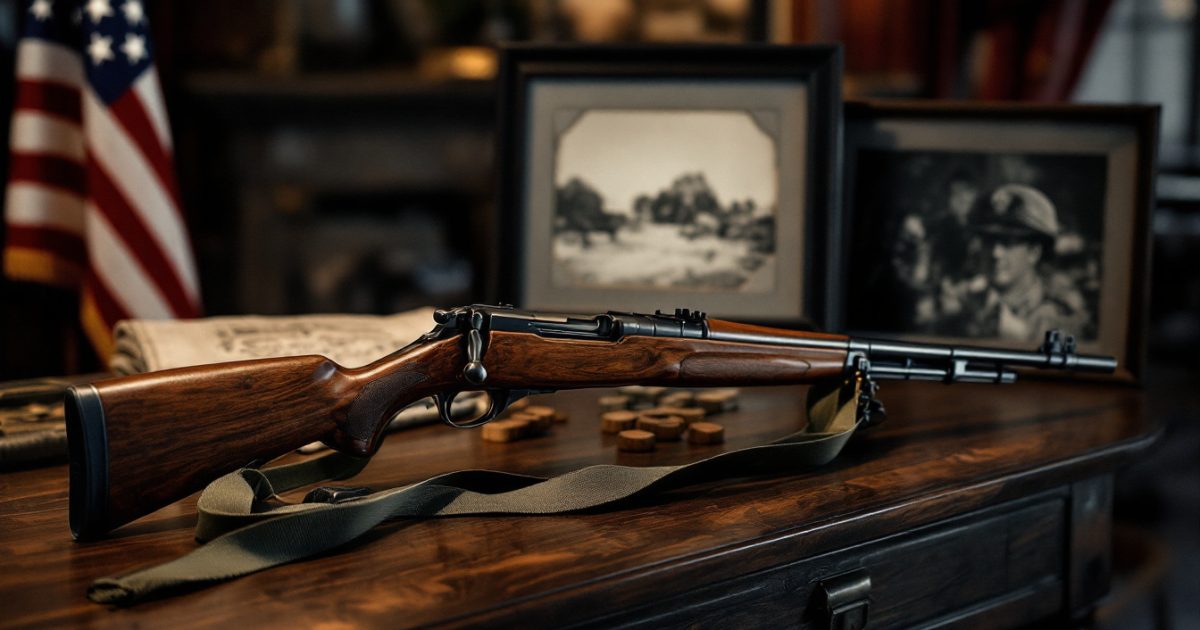
The most important rifle in American history made its inventor exactly nothing.
Not a royalty. Not a bonus. John Cantius Garand signed every patent over to the United States government — freely — and went back to his bench at Springfield Armory. When Congress floated a bill to award him $100,000 for his trouble, it failed. He kept coming to work anyway, until he retired in 1953.
Hold that thought while we talk about what he built.
Fifteen Years at the Bench
Garand was born in Quebec in 1888 and came to Connecticut as a kid, where he went to work in a textile mill — sweeping floors, then running the machines, then fixing them. Nobody sent him to engineering school. The mill floor was the engineering school.
In 1919, Springfield Armory hired him to crack the problem every army on earth had failed to crack: a semi-automatic rifle you could actually issue by the millions. Rugged enough for mud and sand. Simple enough for a scared nineteen-year-old draftee. Chambered for a full-power cartridge, because the Army wasn’t giving up the .30-06.
It took him more than fifteen years of prototypes, trials, and Army boards moving the goalposts. In 1936, the United States adopted his design as the M1 — and became the only major power on the planet to march into World War II with a standard-issue semi-automatic rifle.
What Eight Rounds Meant
Picture what everybody else was carrying. The German had a Mauser. Bolt action. The Japanese soldier had an Arisaka. Bolt action. The British Lee-Enfield was quick for a bolt gun — but every shot still cost the man his sight picture while he ran the bolt.
The American kid had eight rounds of .30-06 that fired as fast as he could press the trigger, eyes on the target the whole time. Empty clip kicks out, shove in a fresh eight, back in the fight. In January 1945, General George S. Patton — a man who did not hand out compliments — put it in writing: “In my opinion, the M1 rifle is the greatest battle implement ever devised.”
The M1 fed from an en-bloc clip: the clip goes into the rifle with the ammo, and when the last round fires, the rifle spits the whole steel clip out. That design gave us two pieces of shared American heritage.
First, M1 thumb. Load it careless, let the bolt slam home on your thumbnail, and you joined a fraternity millions of GIs belonged to. Nobody joined twice.
Second, the ping — that bright ring of the ejecting clip. The most famous sound in small arms.
About That Ping
You’ve heard the legend: the enemy listened for the ping, knew your rifle was empty, and charged.
Great story. Thin evidence. An Army research memo written in 1952 — while the shooting in Korea was still going on — found riflemen considered the ping useful, as a signal to reload. In a survey of 315 men who carried the M1 in Korea, most wanted it kept; only about a quarter thought it ever helped the enemy. And in an actual firefight — eight other Garands working, a BAR hammering, artillery somewhere behind it all — nobody is picking one ping out of that racket.
Did some GI somewhere toss an empty clip on a rock to bait an enemy into standing up? Every war tells that story. But the fatal-flaw version doesn’t survive contact with the men who actually carried the rifle.
Five Million Strong
More than 5.4 million M1s came out of American factories between 1937 and 1957. They went ashore at Normandy and Iwo Jima, up the boot of Italy, through the frozen hills of Korea. From the day it was adopted to the day the M14 replaced it, the Garand was the rifle in the American infantryman’s hands through the most consequential fighting in this country’s history.
You Can Still Buy One From Uncle Sam
Here’s the ending this story deserves.
The federal government still runs a program — the Civilian Marksmanship Program — whose actual, chartered purpose is to take surplus military rifles and sell them to law-abiding citizens. Qualify, do the paperwork, and a rifle that may have gone up a beach in 1944 arrives at your door. Not a replica. The rifle.
Sit with that. Somewhere in the federal code is a program built on the old assumption that the citizen and the soldier are the same man at different moments — that the service rifle belongs, eventually, in the hands of the people it served. That’s not a loophole somebody forgot to close. That’s the design.
John Garand never collected his royalty. But every Garand sitting in a civilian safe — cleaned, shot on Saturdays, handed down to a grandkid — pays him in the only currency he ever seemed to care about: the work, still working.
Patton said it was the greatest battle implement ever devised. He was right. He just left out the second half — so was the man who built it, and he charged us nothing.