Open a case that’s been shut five years and the first thing that reaches you isn’t gun smell. It’s flatter than that, and a little sweet, like a drawer in an old kitchen. That’s oil. Specifically, that’s oil that has spent five years going somewhere other than where you put it.
That smell is most of what you need to know about storing a gun you don’t shoot.
Because a gun that gets handled lives a charmed life. You take it out, you wipe it down, you catch the rust freckle while it’s still a freckle. The gun that never comes out gets none of that and all of the same years, and whatever happens to it happens with nobody standing there to see it.
Clear the famous worry first, because it eats all the oxygen and it’s mostly nonsense. Somebody will tell you that leaving magazines loaded, or leaving a striker cocked, wears your springs out. It’s the most repeated piece of storage advice in American shooting and it’s largely a myth. Springs wear from cycling — compressed and released, over and over. A spring sitting still at a compression it was built for isn’t piling up damage the way people picture it. Magazines come out of long storage loaded and run fine.
What actually gets a stored gun is rust and oil, and the oil is the one nobody sees coming.
People oil a gun generously before putting it away. It feels like love. It’s the problem. Oil doesn’t stay where you set it — it runs with gravity, it creeps into places you never intended, and given enough time the light stuff evaporates and what’s left turns into something closer to varnish. Where it loves to collect is the firing pin channel, a narrow hole with a part in it that has to move fast and move free. Gummed up, that pin moves slow. Slow pin, soft primer hit, click instead of bang.
And the gun doesn’t look broken. It looks perfect. It’s stiff on the inside in a way you cannot see from the outside, and the only way to find out is to take it apart and look.
So go light and go on the outside. A film on the metal barely heavy enough to see. Grease where the manual says grease. Nothing pooled, nothing dripping, nothing sitting in a hole that didn’t ask for it.
Humidity is the one that genuinely eats guns.
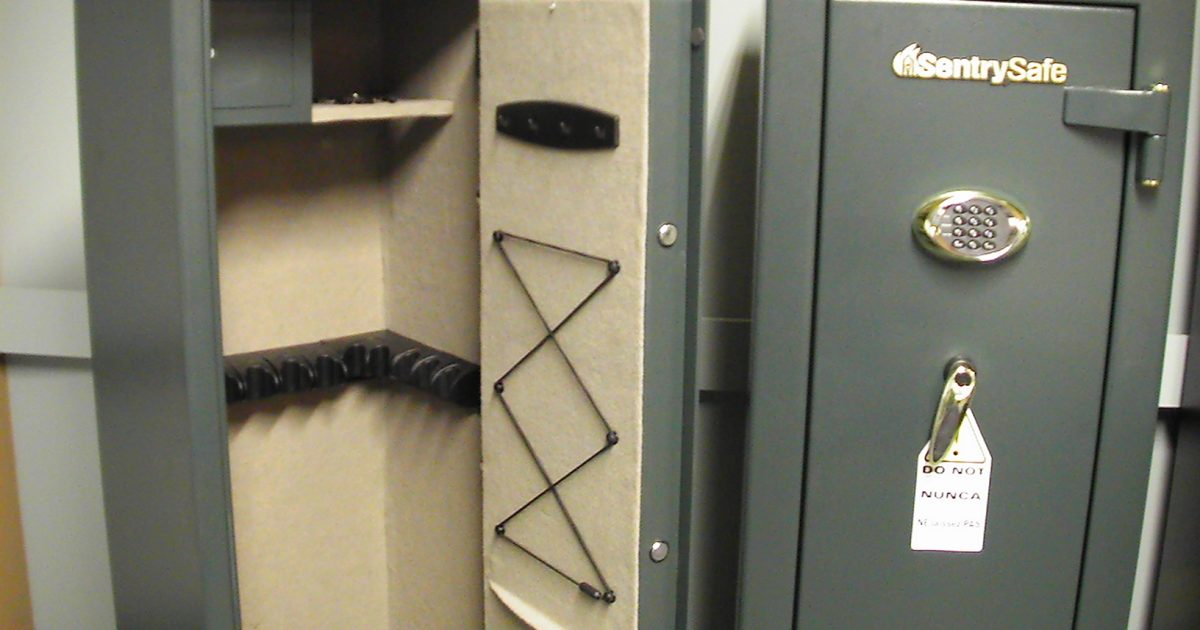
Rust doesn’t need water. It needs damp air and time, and your storage is probably helping it along. The foam in a hard case holds moisture against steel. So does the fleece sock everybody buys at the register. So does the carpet lining in a safe, which looks like care and behaves like a sponge. And the safe is a sealed steel box — whatever humidity was in the room when you shut the door is in there now with your guns, with nowhere else to be.
Which is why a dehumidifier rod or a tub of desiccant does more for what you already own than the next five hundred dollars of gun you could buy. It’s also why a safe inside the conditioned part of the house beats one in the garage, and why a rifle cased up damp after a wet hunt is a rifle you’ll be arguing with come spring.
None of that is about the safe being a safe, which is the other half of this. Safe versus lockbox versus nothing is a question about the people in your house, not about steel. Nothing is a choice too, and it’s the one a houseful of kids and their friends will eventually test. A cheap lockbox stops a curious nine-year-old going through drawers, which is the thing that actually happens; it won’t stop a man with a pry bar, which is the thing people argue about online. And the lockbox you’ll actually bolt down beats the safe you never got around to buying.
Ammunition is easier than people make it, and the worry points the wrong direction. Age alone does very little to modern ammunition. Kept cool and dry it stays good a long, long time. What ruins it is heat cycling and moisture — a car trunk through a summer, an attic that bakes and freezes and bakes again, the corner of a basement that sweats. That’s what degrades powder and corrodes primers and cases. The original box on a closet shelf inside the house will outlast the can you left in the shed, every time.
Here’s the part nobody wants to hear.
The gun you most need to check is the one you never check. The carry gun gets looked at constantly. The range gun tells you the moment something’s off, because you’re standing right there when it does it. The gun in the closet — bought for a serious reason and then quietly trusted for years — gets nothing at all, and it’s the one expected to work cold on the worst night of your life.
Pull it out this week. Unload it, check it twice, wipe it down, run the action, look at the firing pin channel if you know how to get in there. Then write the date on a card and leave the card in the case.
Takes a quarter hour. You’ll finish it knowing something about your own house you didn’t know this morning.