Start in Afghanistan, in the 2000s, with a young American or British soldier looking at a rifle his great-grandfather would have recognized on sight.
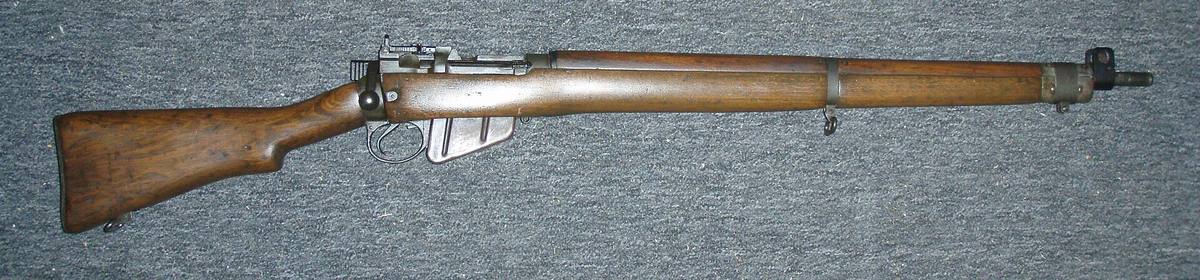
Bolt action. Long wood stock. A box magazine sitting ahead of the trigger guard, holding ten rounds of a rimmed cartridge that stopped being anybody’s front-line ammunition before his father was born. Reporting out of that country through those years kept turning the same rifle up, in the hands of men who weren’t carrying it as an antique. They were carrying it because it worked. Because it hit at distance, because the ammunition was findable, and because a rifle doesn’t care.
That’s the Lee-Enfield. And the reason that soldier’s great-grandfather would have known it on sight is that his great-grandfather very likely carried one.
So walk it backward.
Before it got to those hands it had been through a great many sets of hands along that frontier, some of them holding rifles made in British factories and some holding rifles built by gunsmiths in the tribal belt on the Afghan-Pakistan border. Hand-made copies, turned out with simple tools, stamped with whatever markings the maker felt like stamping. The Khyber Pass copies. Some of them are decent. Some of them are a prayer with a trigger. All of them are a monument to a plain fact about engineering, which is that when a design is good enough, people will build it themselves and not ask anybody.
Back up a little further and the same rifle is standing on both ends of a border that didn’t exist yet.
When the British left the subcontinent and it split into India and Pakistan, the armies that formed on either side of that line were built in large part out of the same inventory. The same rifles. The same ammunition. The same arsenal drawings, the same manuals, in many cases the same men. Then those two armies fought each other. More than once.
Nobody designed that. It’s just what happens when the empire that armed half a continent stops being the one holding the reins.
Keep going back. Through the Second World War, where the Lee-Enfield was the rifle of the British soldier and of soldiers from Canada, Australia, New Zealand, India and a long list of other places — built in factories on several continents, because one country couldn’t make them fast enough. Back through the First World War, where it did the same work in the same way, and did it well enough that stories about the speed of British rifle fire were still getting repeated a hundred years later.
And back past all of that to the 1890s, when Britain adopted a rifle with two names on it, and neither one belonged to a British designer the way people assume.
The Enfield half is a place — the government small arms factory at Enfield Lock, which gave the rifle its barrel. The Lee half is a man. James Paris Lee, born in Scotland, raised in Canada, who did his gun work in the United States. The bolt action and the magazine that armed the British Empire for the better part of sixty years came off the drawing board of a man who spent his working life in America.
So it was never purely British to begin with. It just got called that long enough that everybody believed it, including the British.
Here’s what I take from the whole run of it.
We talk about guns as though they carry a politics. This one’s a patriot’s rifle. That one’s a tyrant’s rifle. This other one says something about the man who bought it. The Lee-Enfield has spent well over a century demonstrating that the entire idea is sentiment, and not much else.
It was an imperial rifle and an anti-imperial rifle. An Indian rifle and a Pakistani rifle. An insurgent’s rifle, and a deer rifle in half the Commonwealth, and a rifle pointed at the grandsons of the men who built it. It did every bit of that without one dimension changing.
A rifle is a mechanism for throwing a bullet accurately. That is the entire extent of its opinions. The cause, the flag, the righteousness or the absence of it — all of that gets supplied by whoever’s holding it, and it gets supplied fresh every time the thing changes hands.
Which cuts both directions, and that’s the part I actually care about. It means no gun is evil, which is a thing we say constantly and happen to be right about. It also means no gun is on your side. Not really. The Enfield was never loyal to the Crown. It was well made, and well-made things get used by whoever ends up with them, for as long as the ammunition holds out.
Men have been shot at with that rifle whose grandfathers were shot at with that rifle, by different people, over different arguments, on different continents.
The rifle’s the same one. We’re the variable.