
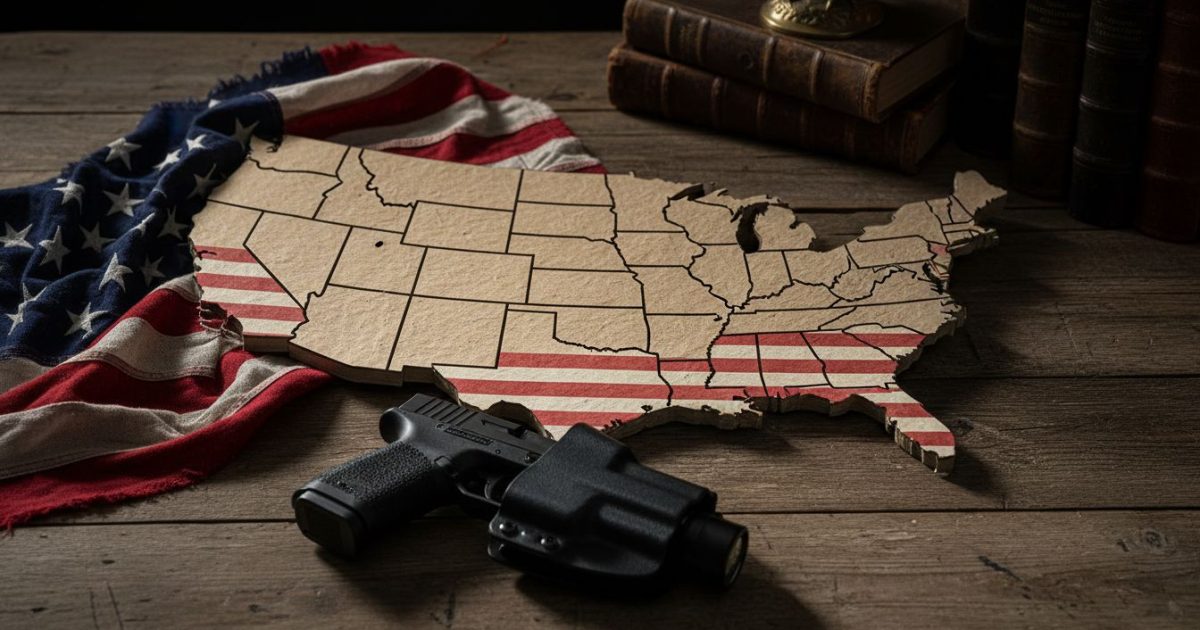
If you can carry a holstered handgun openly down Main Street without a permit, your state still takes the Second Amendment literally. Most don’t — but more than a dozen do, and the list has been quietly growing.
Open carry — visibly bearing a holstered firearm in public — is the original American norm. For most of this country’s history, the idea that a free citizen had to ask the government’s permission to walk around armed would have been considered self-evidently absurd. Today, thanks to a century of incremental gun-control legislation, that original norm has been pushed to the margins. But it’s still alive in a meaningful chunk of the country, and post-Bruen court rulings are slowly pushing it back into the mainstream.
States With Permitless Open Carry (a.k.a. “Constitutional Carry” — Open Variant)
In these states, any law-abiding adult (typically 18 or 21+) can openly carry a handgun in public without any state-issued permit. No paperwork, no fees, no fingerprints, no “may issue” sheriff veto. The Constitution is the permit.
- Alaska — first true constitutional-carry state (2003)
- Arizona — open carry has always been legal; permitless concealed since 2010
- Arkansas
- Idaho
- Kansas
- Kentucky
- Maine
- Mississippi
- Missouri
- Montana
- New Hampshire
- North Dakota (residents only)
- Oklahoma
- South Dakota
- Vermont — the original constitutional-carry state, never required a permit
- West Virginia
- Wyoming
- Tennessee, Iowa, Texas, Utah, Alabama, Georgia, Indiana, Ohio, Florida, Louisiana, South Carolina — added permitless carry between 2021 and 2024
That’s roughly 29 states — a majority of the country — where the right to openly carry a firearm does not require government permission. A decade ago, that number was barely a dozen. The trendline is in our favor.
States Where Open Carry Is Legal — With a Permit
A second tier requires a state-issued concealed-carry or open-carry permit, but otherwise allows it: Connecticut, Massachusetts, Minnesota, New Jersey (de facto restrictive), Rhode Island, Pennsylvania (Philadelphia is the outlier), Utah, and a handful of others. The permit barrier varies wildly — Pennsylvania is fast and shall-issue; New Jersey, until Bruen, was nearly impossible.
The Outliers — States That Ban or Heavily Restrict Open Carry
A small group of states still flat-out bans open carry of handguns: California, Florida (until 2023 — now permitless carry), Illinois, New York, South Carolina (until 2024), and Washington D.C. The pattern is predictable: dense, blue-leaning, urban-political. In every one of these jurisdictions, gun-rights organizations have active litigation challenging the bans on Second Amendment grounds — and post-Bruen, they are winning at unprecedented rates.
Why It Matters
Open carry isn’t just a legal status — it’s a visible statement that the citizens of a state still trust themselves and each other with the means to defend themselves. It’s also a powerful crime deterrent: armed robbery rates are measurably lower in states with permissive carry laws, because criminals can’t tell who’s armed and who isn’t.
The anti-gun lobby has spent decades trying to make open carry socially unacceptable, hoping that if they can’t ban it legally, they can shame people out of doing it. They’ve failed. The number of states moving toward permitless carry has accelerated since the Supreme Court’s 2022 Bruen decision, which made clear that gun-control laws have to be measured against the country’s historical tradition of firearm regulation — not against whatever the legislature happens to fear this year.
Practical Notes If You Open Carry
- Know your state’s rules on what counts as “open” — some states require the firearm to be in a holster, not just visible.
- Federal property is a no-go regardless of state law: post offices, federal courthouses, military bases.
- Schools, polling places, and bars are commonly restricted even in permissive states. Check before you walk in.
- Private property owners can still ask you to leave. “No firearms” signs vary in legal weight by state.
- Train. Train. Train. The right to carry doesn’t come with the skill to use a firearm responsibly under stress. Get to the range monthly at minimum.
Bottom Line
The right to openly bear arms is alive and gaining ground. In well over half the country, your right doesn’t require a government permission slip. That’s the Second Amendment functioning as written — and it’s worth defending in the states that still get it right and worth fighting for in the states that don’t.
