Everybody on that couch has asked you to stop doing this. You are not going to stop doing this.
Somebody on screen lifts a weapon that supposedly fires plasma in a galaxy nobody’s ever been to, and before the actor gets his line out you’ve already said it out loud to a room that did not ask. “That’s a Mauser.” Now everybody knows. Nobody wanted to know. There’s forty minutes of movie left.
The subject’s having a moment, too — Brandon Herrera put up something called “Testing the Real Life Mandalorian Pistol” on September 23rd and it’s past 1.1 million views. So a lot of people are thinking about screen guns this week. The answer they’re circling has been sitting in plain sight since 1977.
You weren’t imagining it. It really was a Mauser.
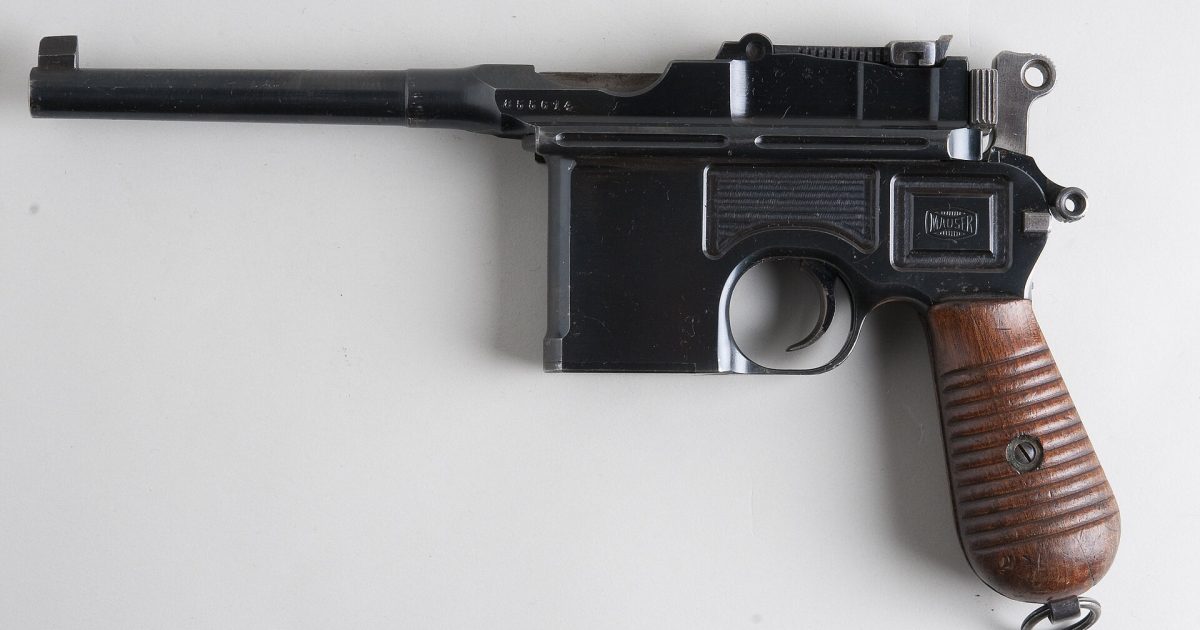
Han Solo’s blaster started life as a C96 — the broomhandle, that odd German pistol from the 1890s with the magazine stuck out ahead of the trigger guard. Bolt some hardware to it, add a scope that doesn’t do anything, and there’s the most famous sidearm in movie history. The stormtrooper carbine was a Sterling, the British submachine gun with the magazine hanging off the side, which is exactly why that silhouette reads so wrong and so right at the same time. The big squad gun the troopers hauled around was built on an MG34, a German machine gun from the thirties, drum and all.
None of that was a secret and none of it was an accident.
Before a computer could draw a gun, the cheapest way to get a convincing one on camera was to go buy one. A real firearm shows up with every problem already solved. It has weight, and weight is the whole game — an actor holds four pounds of machinery differently than he holds two pounds of resin, and the camera catches that even when the audience can’t name it. The balance is right because somebody engineered the balance. The hand falls where the hand falls. Load blanks and you get real flash and real cycling, a bolt actually running, brass actually leaving, all of it in-camera and none of it on the effects budget.
So the prop shops glued space junk onto real guns and went to lunch. The trade even has a word for the glued-on nonsense: greeblies. Bits of model kits and plumbing and scrap, stuck on to make a thing look like the future. Underneath the greeblies, a machine gun.
It was never just the one franchise, either. The pulse rifle in Aliens — the one with the little counter on the side that every one of us has wanted since we were fourteen — is a Thompson under a shroud, with a Remington 870 pump doing the grenade launcher work below it. Deckard’s blaster in Blade Runner is two real guns married into one. Pull that thread and half the iconic weapons of the last fifty years come apart into hardware you could look up in a catalog.
Which brings us back to your ruined movie night.
What’s happening when you blurt it out isn’t knowledge, exactly. You never sat down and memorized receiver profiles. You spent thirty years handling this stuff and your eye filed away a few hundred silhouettes without asking your permission first. So when one goes past on screen with a radiator bolted to it, the back of your head flags it before the front of your head gets a vote. It’s the same reflex that tells you a used gun’s been abused from clear across the shop. It just fires at the worst possible social moment.
Every gun person alive has done this to somebody on a couch. It might be the only genuinely universal experience left in gun culture.
Now the honest part, because that era is mostly over. Modern productions run on replicas, rubber, resin, airsoft, and muzzle flash painted in afterward. Cost drives some of it, safety drives more, and insurance quietly drives the rest. That’s a fair set of arguments and I’m not going to pretend it isn’t. If a shot can be made without a live firearm on set, there’s a real case for making it that way.
But something does go out the door with it, and it’s worth naming, because it’s the whole reason those old props still hold up while plenty of newer ones look like toys the second the lighting goes flat.
The old stuff was real machines first. Drawn up by people solving actual problems — how to feed a cartridge, how to eat recoil, how to put a hand somewhere it can control the thing. Every line on a C96 is there because it had a job. A prop built from scratch to look dangerous is built by somebody solving a completely different problem, which is how a shape reads in a frame.
Your eye knows the difference. It just can’t explain itself, so it says “that’s a Mauser” instead and ruins the movie for everybody.