What people want is a way to make a man stop without making him dead.
That’s the whole wish, and it’s sat in every honest gun owner’s head since the first time he thought hard about what a hollow point does to a human body. It isn’t cowardice and it isn’t naivete. It’s a decent person running the math on the worst night of his life and hoping somebody built a third answer.
Kentucky Ballistics put up a video two days ago titled “This Device CATCHES Your Bullet !!! (The Alternative Less Lethal).” It’s past 1.4 million views. One of the biggest firearms channels on the platform, and in forty-eight hours a million and a half people clicked the word “alternative.”
I haven’t watched it, and I’m not going to tell you what’s in it. All I’ve got is the title. But I’ve heard that question across a counter for years, and it deserves a straight answer instead of a smirk.
Start with the word in his title. Less lethal. Not non-lethal. The industry changed that language on purpose, and not for marketing — the opposite. Non-lethal was a promise nobody could keep. People have died from beanbag rounds, baton strikes, rubber projectiles, being tased. Not often. Often enough that everybody quietly stopped saying a word that wasn’t true.
The reason is mechanical, not legal. Anything with enough authority to stop a determined man has enough authority to kill one. You don’t get the first without accepting the risk of the second. That’s physics, and no product name gets around it.
Now the part people have backwards, which is the part that matters.
In most of this country, the legal justification for using deadly force is a reasonable belief that you’re facing imminent death or great bodily harm. That’s the bar. Self-defense law varies state to state and I’m not a lawyer, so take this as the general shape and not legal advice — but some version of that standard is what you’ll be measured against nearly everywhere.
Run it both directions.
If you’re not facing that — the guy’s drunk and loud and in your yard and scary, but not about to kill you — reaching for a less-lethal device doesn’t turn an unjustified use of force into a justified one. You used force on a human being, you’re going to explain it to somebody in a uniform and maybe to twelve people in a box, and “it wasn’t lethal” is not the defense people assume it is.
And if you are facing that? Then you’ve chosen to answer a lethal threat with something that might not stop him. That isn’t a moral upgrade. That’s a bet with your life sitting on the table.
The bar doesn’t move. Less lethal doesn’t lower the standard. It only changes what you’re holding when you meet it.
Which is why these tools mostly live on a duty belt.
A cop or a corrections officer has a problem you don’t have. He has a duty to engage a person he isn’t legally allowed to shoot. He can’t leave. He can’t lock the door and dial somebody. He has to put hands on something violent but not deadly, and he needs an option between his voice and his sidearm.
He’s also got things you don’t. Training on that tool, on a schedule, and help rolling the second he keys the mic. And the one civilians skip past: usually a second officer standing there with a firearm out, covering him, in case the less-lethal option doesn’t work.
That’s the entire system. The less-lethal tool works out there because a lethal one is backstopping it from three feet away.
You, at two in the morning, in your own hallway, are the whole department. Nobody’s covering you. Just you and whatever you picked up off the nightstand.
None of this means less lethal is stupid.
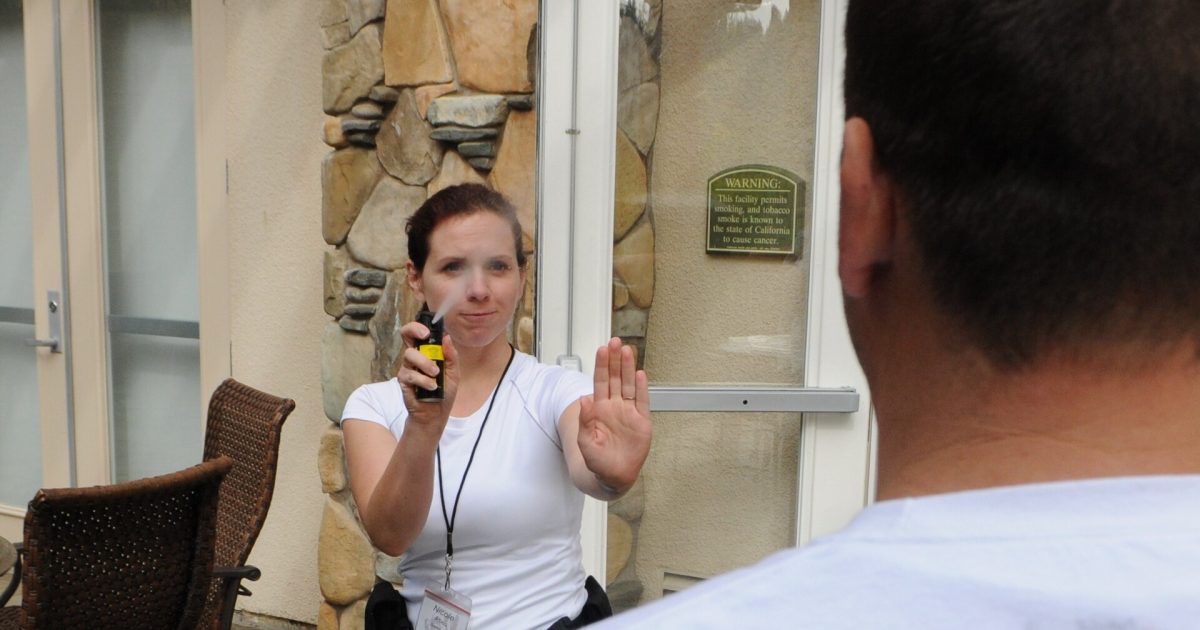
Pepper spray is genuinely good and I’ll tell anybody that. It’s cheap, it works well enough, and it rides along in places your pistol legally cannot go. The courthouse. The campus. The state you’re just driving through. And it fits the situations that are ugly without being deadly. The belligerent drunk in the parking lot. The loose dog. The guy following you who needs convincing to stop and nothing further.
Those nights are far more common than the hallway at 2 a.m., and a gun is the wrong answer to all of them. Carry the spray. Burn an inert can in a parking lot first, so the time you work the top isn’t the time it counts.
The trap is this, and it’s why I wrote this down.
Some people buy a less-lethal device to avoid answering a question. The question is whether you’re willing to kill a person to protect yourself or somebody you love. It’s an ugly question and it ought to be. Anybody who answers it cheerfully worries me. But you don’t get to skip it by buying something. The gadget doesn’t decide. You do, beforehand, at a kitchen table, in the daylight, while nothing is happening.
A million and a half people went looking for a third option in two days. I understand it. I’ve wanted one too.
There just isn’t a product that answers the question for you. There’s only the answer you give first, and the tool you pick up after.