
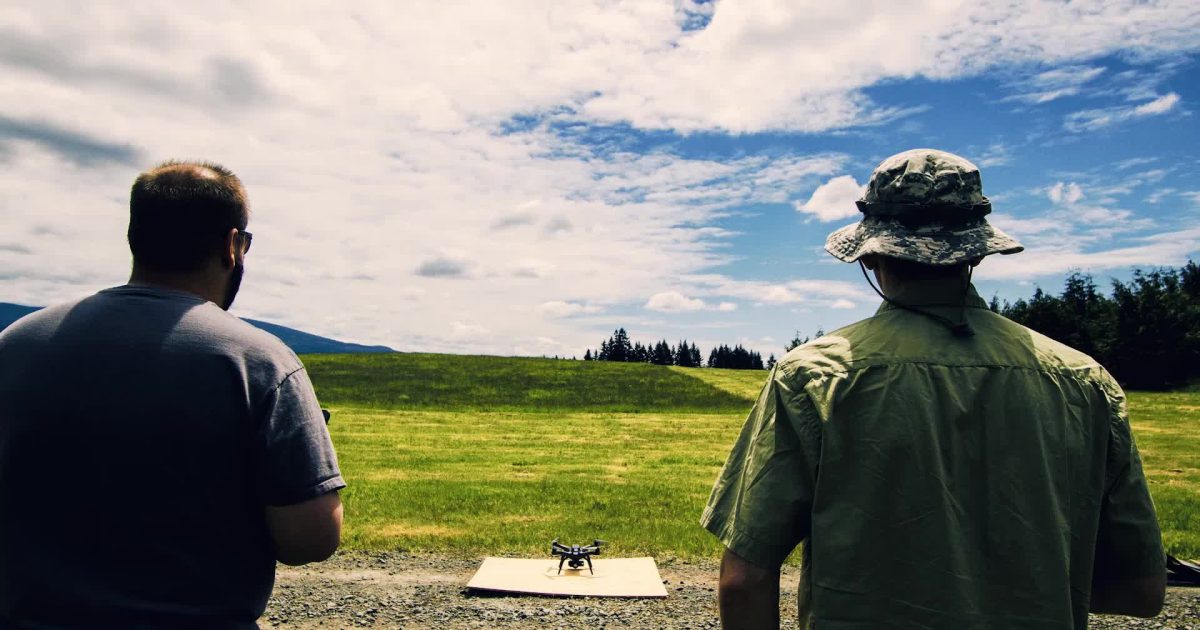
There’s a quadcopter parked sixty feet over your back fence on a Saturday afternoon, nose tipped down, not going anywhere. Your kids are on the swing set underneath it.
You know the thought you had. Everybody has it. The 20-gauge is nine steps away in the hall closet and the whole thing resolves itself in about a second and a half.
Don’t.
Not because it’s rude. Because the federal government considers that thing an aircraft, and there’s a felony statute waiting on the other end of it.
That’s the part that catches people flat. The word aircraft, in federal law, doesn’t mean what your ear says it means. The definition in the code is broad enough to cover damn near anything that flies, and the FAA has been consistent for years that unmanned aircraft are aircraft. Small doesn’t matter. Plastic doesn’t matter. Four hundred bucks from a big-box store doesn’t matter.
Which lands it under 18 U.S.C. § 32 — damaging or destroying an aircraft, a federal felony, written back when Congress was thinking about airliners and dynamite. Nobody drafting it pictured a man in a bathrobe with a shotgun. People have been arrested and charged federally for exactly this.
It’s on my mind because Garand Thumb, one of the biggest firearms channels on YouTube, put up a video yesterday called “How To Use Drones In War.” Past 240,000 views already. I haven’t watched it and I’m not telling you what’s in it. But when a topic gets everywhere, the question underneath it starts getting asked out loud at gun counters. This is that question.
So let’s take the follow-ups in the order people actually raise them.
“It was over MY property.” Your property line does not run to the moon. The Supreme Court sorted the shape of this out back in the forties, in a case brought by a man whose chickens kept killing themselves every time military planes came in low over his farm. The old notion that a landowner owns the sky clear up to the heavens didn’t survive it. You own the part of the air you can actually use with your land — and owning something has never been the same as being allowed to shoot at aircraft in it. A man walking across your lawn uninvited is trespassing too. You still can’t shoot him for it.
“But he’s filming my house.” Might well be illegal, and I’ll get to where that goes. It doesn’t cancel the other thing. Two separate proceedings, two separate outcomes, and one of them is yours to carry regardless of how the other one lands.
Then the physics nobody wants to hear. Shot goes up, shot comes down. You’re standing in a neighborhood angled at the sky and every pellet in that pattern has an address it hasn’t picked yet. Your neighbor’s roof. Your neighbor’s kid. That’s an entirely different set of consequences, arriving before anybody in a federal building has even heard your name.
Plain line, and I’ll only say it once: this is general information, laws vary by state and by town, and it isn’t legal advice. Live situation, talk to somebody licensed where you live.
Now the useful part.
Document it. Video of the thing, time, date, how long it sat there, which direction it went home to. One incident is a story. Six incidents with timestamps is a case.
Call local law enforcement on the non-emergency line, and get a report number every single time — even when the responding deputy shrugs, and especially then. The report number is the thing that still exists later.
There’s an FAA complaint process too. A lot of drone flying is governed by federal operating rules with real teeth in them, and some of what makes a man furious in his own backyard is also a violation of the rules that operator is supposed to be flying under.
And then the one that actually bites: your state’s privacy and voyeurism statutes. A pile of states have written drone-specific surveillance and peeping laws in the last decade, and that’s increasingly where these cases land. He isn’t in jeopardy for flying. He’s in jeopardy for what he pointed the camera at.
While we’re here — jamming. The gadgets that knock a drone down electronically are federally restricted for private citizens, selling and operating both. The counter-drone authority Congress handed out went to a short list of federal agencies, and your address isn’t on it. Skip it.
Now the honest part, which most people writing this stuff won’t put on paper.
That answer stinks.
Somebody hovers a camera over the yard where your kids are playing and what the law offers you is: take good notes. It does not feel like enough, and anybody who tells you that being angry about it makes you a hothead has never had it happen over his own fence.
You’re not wrong to be angry. The trouble is the felony is real whether your anger is justified or not, and the felony is yours to eat.
So get the video. Get the report number. Find out what your state says about cameras pointed into private places, because it probably says more than you’d guess.
The law’s answer is take notes. It’s a lousy answer. It’s also the only one that leaves you standing in your own backyard next weekend instead of explaining yourself to a federal prosecutor.