Somebody had to yell for fire.
That’s the detail that stuck with me. Eight men on a beach in the dark, a fight already started, and one of them is hollering for a firebrand so the rest of the party can get their guns working.
This is the winter of 1620, before there was a Plymouth to speak of. An exploring party is out looking for a place to put the colony. They’re sleeping rough on Cape Cod. Around five in the morning the camp starts to stir, and a couple of the men who aren’t sure their pieces will even fire go ahead and shoot them off to check — which tells you most of what you need to know about the gear.
Then the Nauset come at them.
Now. Before the comment section writes itself: those men had spent the previous few weeks helping themselves to seed corn out of Nauset storage pits, and six years earlier an English ship had carried off a boatload of people from that same stretch of coast to sell. The Nauset had the receipts. Read it however you want, but don’t read it as a surprise.
What I want to talk about is what happened in the next thirty seconds, because it’s the most useful thirty seconds in American gun history and almost nobody tells it.
Two men got shots off immediately. Myles Standish was one of them. A second followed, and by the account there may have been a third.
Everybody else stood there holding a club.
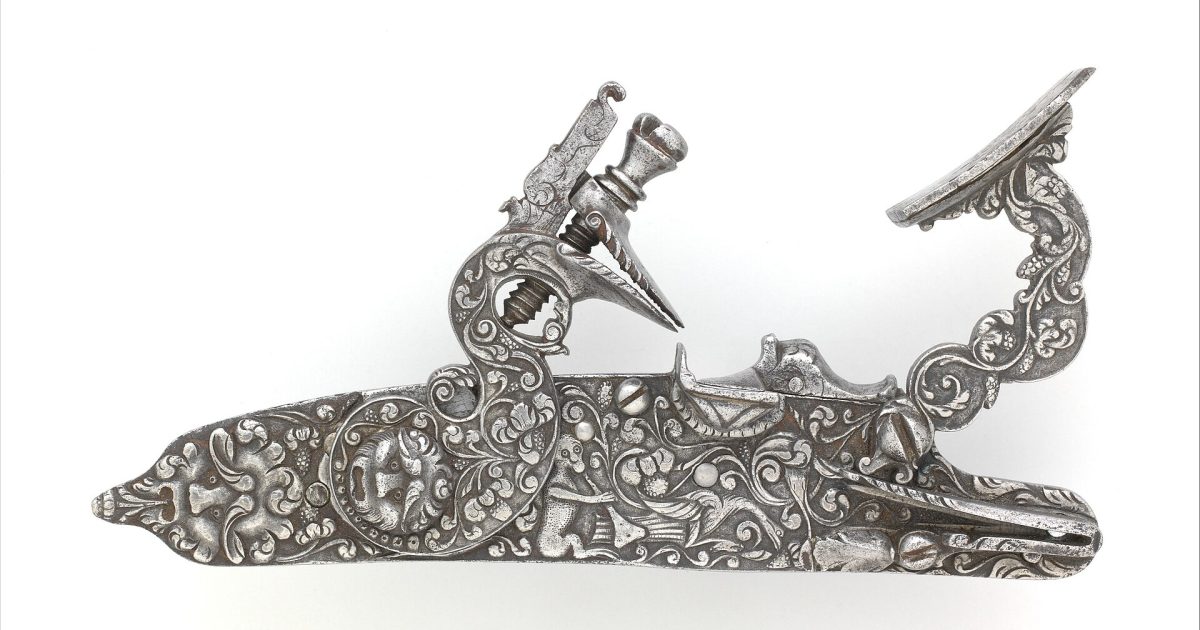
Because here’s the thing about a matchlock, which is what most of them had. It is a beautifully simple gun. A cord — real cord, soaked in saltpeter so it smolders slow and hot instead of flaring out — gets clamped into a curved piece of metal called a serpentine. You pull the lever, the serpentine swings the burning end of that cord down into a pan of priming powder, the pan flashes, the main charge goes. Nothing to break. Cheap. If it does break, you can fix it with what’s in your pocket.
And it is one hundred percent useless unless you are, at that exact moment, already carrying a lit piece of rope.
Not “can light.” Lit. Burning. Right now, in your hand or clipped to you, in the dark, in the wind, on a beach, in December.
Standish and the other one or two had something else: a snaphaunce. Flint held in a cock, driven against steel, sparks into the pan. No fire needed in advance. You carry it loaded and primed and it goes when you decide it goes.
That is the entire difference. Not range. Not power. A matchlock and a snaphaunce throw the same ball out of the same length of barrel at about the same speed. The difference is the number of steps between “I have a gun” and “I have a gun that works,” and on that beach the number was either zero or it was send-a-man-running-for-fire.
While we’re here, let’s kill the picture on the greeting card. The round-hat, buckle-shoe fellow with a turkey over one shoulder and a bell-mouthed blunderbuss over the other never existed. Blunderbusses didn’t turn up in England until the middle of that century, a good thirty-plus years after any of this. The Pilgrim blunderbuss is a costume, invented later by people who needed the silhouette to read as “old.”
Here’s a better one anyway. The first firearm these people ever got into the written record wasn’t fired at anybody. The Mayflower is sitting at anchor off Provincetown and John Billington’s boy Francis gets into his father’s fowling piece, which is sitting in the family cabin loaded, and touches it off. Sets the cabin on fire. In a wooden ship. With, as the account carefully notes, “many flints and iron things about the cabin.”
Historians read that scene for ignition systems — a kid could make it go, and there were flints all over, so Billington’s gun was a flint gun, not a matchlock. I read it for something else. Four hundred and six years ago, in the first week anybody in that colony wrote anything down, a boy found a loaded gun that an adult left where he could reach it. We’ve been having that conversation ever since.
What I keep coming back to is that none of these men were fools about it. Flint arms cost real money. Matchlocks were the budget option, and a lot of those families were spending everything they had just to get on the boat. So most of what landed at Plymouth was matchlock, with flint for the ones who could swing it — which is exactly the same math as a guy today buying the gun he can afford and promising himself he’ll fix the rest of the setup later.
They did fix it. By the 1640s Bradford could write that the colony’s troops mustered with flint arms, all of them. In 1677, Plymouth’s court went the whole way and simply outlawed the matchlock for militia use. Took about two generations to stop needing a campfire to defend yourself.
The gun was never the problem on that beach. Every one of those muskets was a working firearm. Half of them were just parked two minutes away from being one.