There is a conversation that happens at every range in America, usually around a man’s fiftieth birthday, and it always starts the same way.
“I don’t know what’s wrong with this gun.”
The gun is fine. The gun has not changed a thing. What changed is that somewhere around forty-five, the lens inside your eye stopped being able to shift focus the way it did when you bought it — and the single most important thing in shooting a handgun accurately is a sharp front sight.
You can’t get one anymore. Not the way you used to.
That’s not a decline you have to accept, and it’s not a reason to go buy a different pistol. But you do have to understand it, because almost everything people try first makes it worse.
Why It Happens, In Plain Terms
Your eye focuses by changing the shape of a flexible lens. Small muscles squeeze it rounder to focus close, relax to focus far. You’ve been doing it a few hundred thousand times a day since you were born.
That lens stiffens with age. It starts in your twenties and nobody notices, and somewhere in the mid-forties it crosses the line where you can’t pull focus to arm’s length anymore without help. It’s called presbyopia, it happens to every human being who lives long enough, and it has nothing to do with how good your distance vision is.
That’s why the guy who still reads road signs a mile off is the same guy holding the menu at arm’s length.
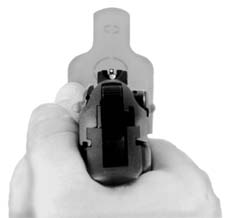
Now put that in a shooting stance. A proper sight picture asks your eye to do something genuinely hard: hold a crisp front sight at about arm’s length while the rear notch sits closer and the target sits yards away. Three distances, one lens.
A young eye cheats its way through that by snapping focus around faster than you notice. A fifty-year-old eye can’t. So you get a soft, fuzzy, slightly doubled front sight — and a fuzzy front sight means your groups open up. Not by a little, either. Small errors in sight alignment multiply with distance.
Here’s the test that proves it’s your eyes and not your shooting. Put the gun on a rest, or shoot from a solid braced position where the gun genuinely cannot wander. If the groups tighten way up, your trigger press was never the problem. If they stay open, keep reading anyway, but get the sight thing fixed first.
The Three Fixes, Worst To Best
Focusing on the target instead. This is what everybody does on their own, usually without deciding to. The target is big and far away, so it’s the easiest thing in the picture to see, and the eye drifts there on its own.
It feels better. It shoots worse. With the target sharp, both sights go soft, and alignment errors you can’t see are the ones that put rounds where you didn’t want them. If you take one thing from this: the front sight is the thing that must be sharp. The target is allowed to be a blur. That’s not a compromise, that’s correct technique at every age.
Reading glasses, or a shooting-specific prescription. This genuinely works, and it is the cheapest real fix there is.
The catch is that drugstore readers bring the front sight into focus by pushing the target further out of it, and the strength that’s perfect for a book is usually too strong for arm’s length. People do best somewhere around half to two-thirds of their reading strength. If you see an optometrist, tell them specifically that you want to resolve something at roughly arm’s length, and bring the actual distance with you — measure from your eye to where the front sight sits when you’re extended. They will thank you for it, because “I need glasses for shooting” means nothing to them without that number.
Progressive lenses are their own problem. The reading portion sits at the bottom of the lens, which is nowhere near where your eye looks in a shooting stance. Plenty of people end up tipping their head back to find the right part of the lens, which wrecks everything else. Dedicated single-vision shooting glasses solve that for about the price of a case of ammo.
A red dot. This is the actual answer, and the reason is physics rather than fashion.
A red dot sight puts the aiming reference on the same focal plane as the target. There is no near-object and far-object to reconcile. You look at the target, the dot is on the target, and your stiff lens is never asked to do the one thing it can no longer do.
For an aging eye, this isn’t an upgrade. It’s a workaround for a specific disability, and it’s the only one that removes the problem entirely instead of managing it.
Two honest cautions. If you have astigmatism, the dot may look like a comma, a starburst, or a small flock of birds. A smaller dot and lower brightness help a lot, and most people who complain about this have the brightness cranked far higher than they need. Try someone else’s before you spend money. Second, a dot has to be found on presentation, and finding it is a learned skill that takes real repetitions. Iron sights are more forgiving of a sloppy presentation. Budget the practice.
Three Things That Help No Matter What You Do
Clean the actual glass. Your shooting glasses, your prescription lenses, the dot’s window. A film you stopped noticing six months ago is costing you more sharpness than any gear change will get back.
Get more light on the front sight. Fiber optic front sights collect ambient light and are dramatically easier for an older eye to pick up. A bright, high-contrast front sight — fiber, or a wide painted one — is the cheapest meaningful improvement available to you, and it costs less than a tank of gas.
Have your eyes actually examined. Not the vision screening at the DMV. A real exam. Presbyopia is universal and boring, but the same age bracket brings cataracts, glaucoma, and macular changes, and a surprising number of men find out about the first one when they go in asking why they can’t see a front sight. Cataracts in particular come on slowly enough that nobody notices the dimming, and they are extremely fixable.
The Part Worth Saying Plainly
Nobody shoots worse because they got older. They shoot worse because they’re trying to use a sight picture built for an eye they no longer have, and nobody ever told them that was the problem.
The gun didn’t change. Your technique didn’t fall apart. A lens inside your head got stiff, exactly on schedule, exactly like it does for everyone.
Buy the right glasses, or buy the dot. Put a bright front sight on the gun. Then go find out what your actual groups look like.
You will probably be annoyed at how many years you spent blaming the trigger.