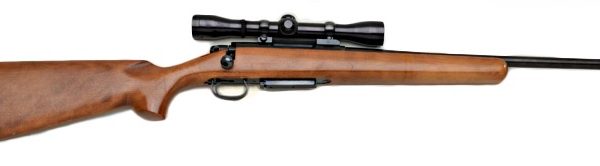
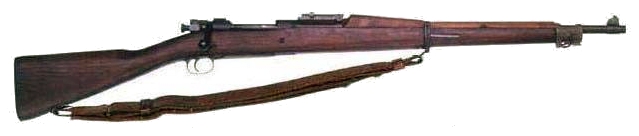
There’s a rifle like this in the back of somebody’s safe in your family. Long, heavy, a bolt handle that comes back like a door latch, and a stock that somebody’s grandfather sanded in 1954 because he thought he was helping.
It exists because the United States Army got out-shot and wrote it down.
Cuba, 1898. The Park Service, which runs what’s left of the Springfield Armory and keeps the institutional memory of the place, puts it about as plainly as a federal agency ever puts anything: in the Spanish-American War, the Krag-Jorgensen rifle “did not perform as well as the rifle issued to the Spanish soldiers.”
The rifle issued to the Spanish soldiers was a Mauser.
Now sit with what the Army did next, because it is not what institutions usually do. They didn’t commission a study about morale. They started work on a new rifle while the war was still going on, and the thing they built was, in the Park Service’s own words, “based on the German Mauser action.”
It took them three tries.
The M1900 was the experiment, and the experiment told them exactly how bad it was. Two findings, both of them humbling. The Krag cartridge didn’t have the Spanish Mauser’s velocity or its range. And — this is the one that mattered more — “the Krag’s loading system was deficient.” The Krag loads through a side gate, one round at a time, like feeding a parking meter. The Mauser took a stripper clip and five rounds went in at once. In a fight that is not a small difference. That is the whole fight.
The M1901 fixed it with an action the Park Service describes as “very similar to the Mauser,” running a rimless cartridge. The M1902 changed almost nothing — “only minor changes were made in the M1901 to produce the version that was approved for production” — and that became the 1903.
Five years from getting beaten to building the answer. I’ve watched procurement take longer than that to pick a holster.
But here’s the part I actually wanted to tell you, because it’s the part that’s still sitting in your gun cabinet whether you own a Springfield or not.
They tested barrel length, and they found that twenty-four inches did everything thirty inches did.
Understand what that meant in 1903. The Army ran two different long guns — a long rifle for infantry, a short carbine for cavalry, two supply chains, two sets of parts, two of everything. The 24-inch finding collapsed that into one rifle that both branches could carry. Not because somebody wanted a handier gun. Because the data said the last six inches weren’t buying anything.
Every argument you have ever had at the counter about barrel length — every guy insisting he needs the 26-inch tube, every guy who cut his down to 18 and swears he lost nothing — is a re-run of a test the Army finished before your grandfather was born, and they landed in the middle on purpose.
They made more than a million of them at Springfield between 1903 and 1936, with, as the Park Service dryly notes, “many modifications.” Rock Island Arsenal in Illinois built another third of a million. The thing stayed in production more than a third of a century, which no modern service rifle has come close to.
So when you pull that one out of the back of the safe this weekend and somebody’s nephew asks what it is, you’ve got a better answer than “it’s old.”
It’s the rifle we built because we admitted we’d been beaten. Which is a harder thing for an army to do than build a rifle.